

01dragonslayer
VET
- Joined
- Apr 8, 2018
- Messages
- 2,623
When it comes to bodybuilding and nutrition, understanding both the glycemic index (GI) and glycemic load (GL) of various foods can provide some useful insights. While the glycemic index is a relative ranking of how different carbohydrates affect blood sugar, the glycemic load takes into account both the quality and quantity of carbohydrates consumed.
The GI is a rating system that ranks carbohydrates on a scale of 1 to 100, based on how much they impact blood sugar. Processed foods such as store-bought candies, breads, cake, and cookies typically have a high GI, while whole foods such as unrefined grains, non-starchy vegetables, and fruits tend to have a lower GI. Carbohydrates with a low GI value are digested, absorbed, and metabolized more slowly by the body than their high-GI counterparts. They typically cause a lower and slower rise in blood sugar levels and, subsequently, insulin response. Foods that are primarily sources of fat or protein are not included in the index because they have a minimal impact on blood sugar levels.
Some critics of the GI system note flaws that can make it an unreliable measurement. GI looks solely at the carb count. Basing a diet around GI only means you would be ignoring other helpful information to determine the true health value of a food.
The GI index does not take into account:
To overcome some of the issues with glycemic index, researchers developed the glycemic load (GL) measurement. Unlike GI, GL accounts for the quantity of the food being eaten as well.
The main difference between GI and GL is:
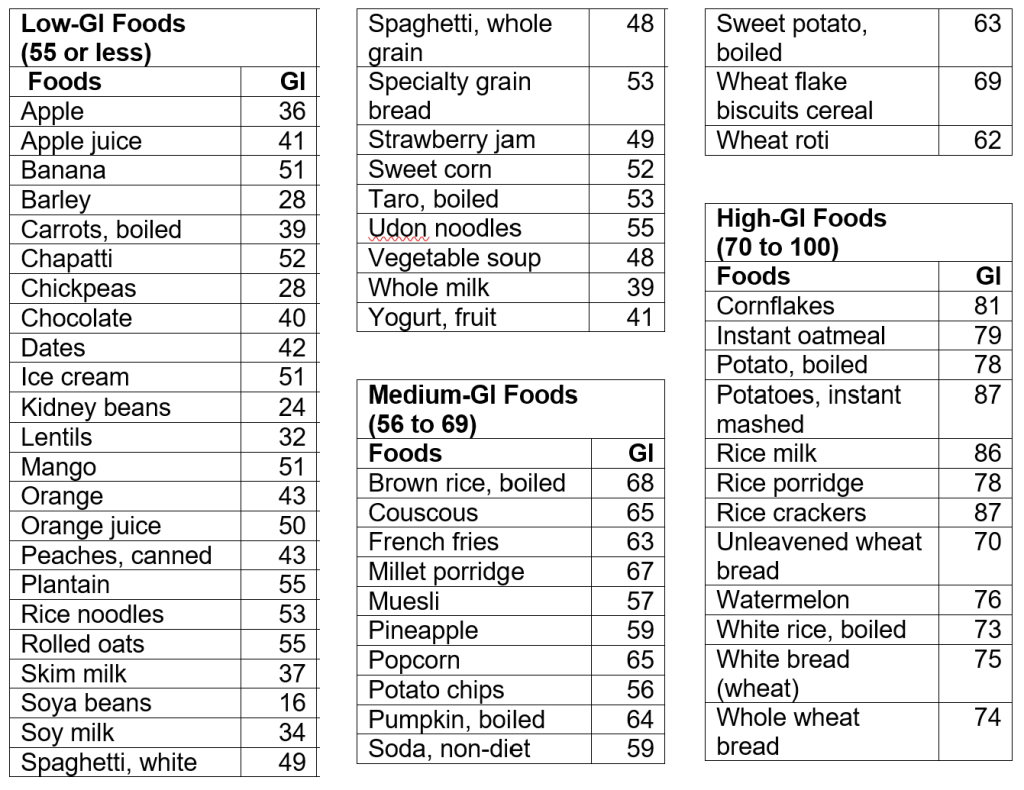
For example, an apple has a GI of 36 and contains 15 grams of carbs. (36 x 15)/100 = 5.4, so the glycemic load of an apple is 5.4.
As a summary, Glycemic index (GI):
The GI ranks carbohydrate-containing foods based on how quickly they raise blood sugar levels.
Glycemic load (GL):
The GI is a rating system that ranks carbohydrates on a scale of 1 to 100, based on how much they impact blood sugar. Processed foods such as store-bought candies, breads, cake, and cookies typically have a high GI, while whole foods such as unrefined grains, non-starchy vegetables, and fruits tend to have a lower GI. Carbohydrates with a low GI value are digested, absorbed, and metabolized more slowly by the body than their high-GI counterparts. They typically cause a lower and slower rise in blood sugar levels and, subsequently, insulin response. Foods that are primarily sources of fat or protein are not included in the index because they have a minimal impact on blood sugar levels.
Some critics of the GI system note flaws that can make it an unreliable measurement. GI looks solely at the carb count. Basing a diet around GI only means you would be ignoring other helpful information to determine the true health value of a food.
The GI index does not take into account:
- How much food is being eaten
- Other nutrients such as protein, fat, vitamins, minerals, and antioxidants
To overcome some of the issues with glycemic index, researchers developed the glycemic load (GL) measurement. Unlike GI, GL accounts for the quantity of the food being eaten as well.
The main difference between GI and GL is:
- Glycemic index is based on eating 50 grams of a specific food
- Glycemic load is based on eating a standard serving size of a specific food
For example, an apple has a GI of 36 and contains 15 grams of carbs. (36 x 15)/100 = 5.4, so the glycemic load of an apple is 5.4.
As a summary, Glycemic index (GI):
The GI ranks carbohydrate-containing foods based on how quickly they raise blood sugar levels.
- Foods with a higher GI value are digested and absorbed more rapidly, leading to a quicker rise in blood sugar levels.
- Foods with a lower GI value are digested and absorbed more slowly, resulting in a slower and more gradual increase in blood sugar levels.
- GI values can be useful for understanding the impact of carbohydrates on blood sugar levels.
- Foods are usually divided into low, medium and high-GI. Here are some examples:
Glycemic load (GL):
- The GL takes into account both the quality and quantity of carbohydrates in a food.
- It is calculated by multiplying the GI value of a food by the grams of carbohydrates in a serving and dividing it by 100.
- The GL provides a more comprehensive measure of the overall effect of a food on blood sugar levels.
- GL considers both the speed at which a food raises blood sugar levels (GI) and the amount of carbohydrates consumed.
- Both the glycemic index and glycemic load should be taken into consideration when planning carbohydrate intake for bodybuilding.
- Pre-workout nutrition may benefit from easily digestible carbohydrates with a higher GI or GL to provide quick energy.
- Post-workout nutrition can benefit from carbohydrates with a moderate to high glycemic load to replenish glycogen stores and support muscle recovery.
- However, other factors like total calorie intake, macronutrient balance, nutrient density, and each meal as a whole should also be considered.
- Individual responses to carbohydrates can vary, as one person can be more likely to store body fat when eating higher GI foods due to poor insulin response while others may benefit from it, building lean mass instead.


